

Quick Answer:
In 2025, Boston home prices average around $779,777 (Zillow), reflecting slower growth and creating opportunities for both first-time buyers and investors. With stabilized mortgage rates and more listings available, this is one of the most balanced buyer environments Boston has seen in years.
Introduction
Boston home prices dipping below the $1M mark is more than a headline; it’s a clear market signal. After years of rising costs and intense competition, buyers finally have a window of opportunity.
For first-time buyers, this shift means more listings and less pressure. For investors, lower prices create openings for rental-focused and long-term value properties. In this guide, you’ll see what’s driving the change, tips on how to act now, and which Boston areas are worth watching.
Boston Housing Market Overview in 2025
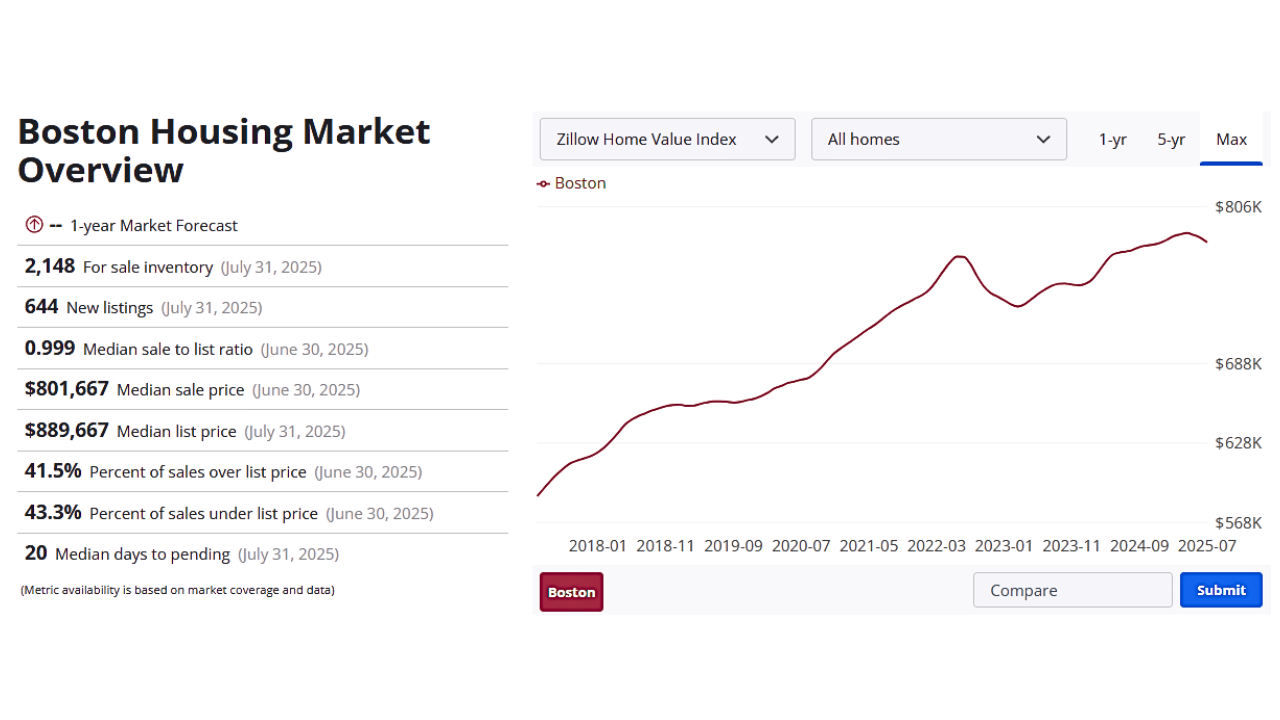
Current Market Snapshot
The average home value in Boston now sits at $779,777, reflecting a modest 0.9% year-over-year increase as of July 31, 2025 (Zillow). While not a steep decline, the market is moving at a slower pace than recent years, offering buyers more breathing room.
Here’s how Boston compares with nearby areas:
| Location | Average Home Value | YoY Change | Source |
| Boston (City) | $779,777 | +0.9% | Zillow |
| Downtown | $1,127,929 | –2.7% | Zillow |
| East Boston | $676,998 | +1.0% | Zillow |
This shows that while Boston overall is still growing, Downtown has cooled slightly, creating openings for investors. East Boston remains more affordable and continues to rise, appealing to first-time buyers.
Curious about what’s on the market today? Check out our featured listings, where you’ll find updated homes across Boston, Newton, Brookline, and more.
Why Home Prices Are Shifting
Several market dynamics are influencing Boston home prices:
- Interest Rates Stabilizing – Mortgage rates are holding steady after the fluctuations of recent years, bringing buyers back with more confidence.
- Inventory Adjustments – More active listings give buyers a wider choice and reduce upward pressure on prices.
- Local Market Nuances – Core areas like Downtown are cooling, while outer areas such as East Boston remain steady, creating a mixed but promising landscape.
What Lower Boston Home Prices Mean for Buyers
For First-Time Buyers
The adjustment in Boston home prices is welcome news for first-time buyers who have long faced affordability challenges. With the city average at $779,777 (Zillow, Realtor.com), buyers now encounter less competition and more opportunities to negotiate.
Bidding wars are less common than in past years, particularly in areas like Brighton and Dorchester. This gives buyers more time to compare options and make informed choices. Stabilized mortgage rates around 6–6.5% also allow for clearer budgeting. Entry-level condos in East Boston, Brighton, and Dorchester remain popular, often priced below the citywide average.
For Real Estate Investors
For investors, moderating Boston home prices open opportunities that were previously out of reach. According to Zillow, Downtown values are softening, while areas such as East Boston and Dorchester continue to show steady growth.
Multi-family properties are especially appealing. Realtor.com data shows more availability of two- and three-family homes compared to previous years. With strong rental demand from universities, hospitals, and tech employers, rental yields can help offset financing costs.
The long-term fundamentals remain strong: limited land, a stable job market, and steady population growth. For patient investors, today’s market offers attractive entry points.
How to Navigate Boston Real Estate in This Market
Smart Buying Tips in 2025
- Get Pre-Approved – Realtor.com reports that properties priced under $800,000 still draw multiple offers. Pre-approval allows buyers to move quickly.
- Focus on Growth Areas – Zillow shows that while Back Bay remains premium, outer areas like East Boston, Dorchester, and Brighton offer better entry prices with growth potential.
- Use Local Expertise – Market trends vary by area. Experienced agents can provide data on average days on market, price per square foot, and rental demand.
Boston Areas Worth Watching
| Area | Median Home Price (2025) | YoY Change | Source |
| Newton | $1.35M | +0.5% | Zillow |
| Brighton | $720,000 | +1.2% | Realtor |
| South End | $1.1M | –2.0% | Zillow |
| Somerville | $900,000 | +0.8% | Realtor |
- Newton: High values but stable, popular with families.
- Brighton: More affordable, strong rental demand.
- South End: Slight softening, opportunities for buyers.
- Somerville: Popular with young professionals, supported by transit access.
Frequently Asked Questions (FAQ)
Is the Massachusetts housing market going to cool in 2025?
Yes, signs suggest parts of the Massachusetts housing market may cool in 2025, though trends vary by area. According to recent data, Worcester County and parts of Western MA are showing slower growth, with price drops and longer days on market. In contrast, Greater Boston remains relatively strong, supported by ongoing demand, though higher mortgage rates and affordability pressures are affecting buyer activity.
Historically, real estate markets move in cycles, and Massachusetts is beginning to reflect that pattern. While inventory is still historically low in many areas, buyers may see more negotiation power outside of Boston’s core.
Why are homes in Massachusetts sitting longer on the market in 2025?
Homes are starting to stay on the market longer than in previous years. In the past, many listings in Massachusetts would go under agreement within a weekend, but that pace has slowed. A major reason is buyer hesitation driven by high mortgage rates and economic uncertainty.
For example, a $700,000 home with just 10% down translates into a monthly mortgage payment of over $5,000 at current rates. For many buyers, that level of commitment feels risky in today’s economy, leading them to delay or reconsider purchasing.
This shift doesn’t necessarily mean demand is gone Boston and surrounding areas still see strong interest but it does mean sellers may need to adjust expectations, and buyers may find slightly more flexibility than before.
Conclusion
The adjustment in Boston home prices below $1M signals an important shift in the city’s real estate market. For first-time buyers, it provides an opening into a competitive market. For investors, it highlights new opportunities in multi-family properties and areas with strong rental demand.
While conditions may change, today’s mix of balanced inventory, steady mortgage rates, and slightly softer prices makes this one of the more approachable moments in recent years.
To explore listings and connect with local experts, visit Centre Realty Group.
Disclaimer: This blog is for informational purposes only. Please consult a licensed real estate professional before making financial decisions.
Recent Comments