

The Massachusetts homestead declaration protects up to $500,000 of equity in your primary residence from most unsecured creditors when you file a declaration at the Registry of Deeds. Every Massachusetts homeowner automatically receives $125,000 of protection without filing anything, but a declared homestead under MGL Chapter 188 raises that ceiling significantly. Elderly and disabled owners can stack protection up to $1 million.
Key Takeaways
- Massachusetts gives every homeowner an automatic $125,000 homestead protection on their primary residence, with no filing required.
- Filing a declared homestead at the Registry of Deeds raises protection to $500,000 per residence.
- Owners age 62 or older, or those with a qualifying disability, can each claim $500,000 in additional protection, stacking up to $1 million per household under MGL Chapter 188 Section 2.
- The homestead protects against most unsecured creditors but does not block mortgages, tax liens, child support, or pre-existing debts.
- Filing costs roughly $35 at the Registry of Deeds and takes one form.
- Only your primary residence qualifies. Investment properties, second homes, and vacation properties are excluded.
Automatic vs Declared Homestead Protection in Massachusetts
Massachusetts is one of the more protective states for homeowners, and the homestead law works on two tiers. Understanding which tier applies to you is the first step, because the difference between automatic and declared coverage is $375,000 of equity exposure.
What the Automatic Homestead Covers
Since the 2010 update to the Massachusetts homestead law, every owner-occupied primary residence receives $125,000 of homestead protection automatically. You do not file anything. You do not pay a fee. The protection attaches the moment the property becomes your principal residence under MGL Chapter 188.
This automatic tier is useful but limited. In Greater Boston, where the median single-family price in areas like Newton, Brookline, and Belmont sits well above $1 million, $125,000 of protection covers a small fraction of typical home equity. A declared homestead is where meaningful asset protection begins.
What a Declared Homestead Adds
Filing a declaration of homestead raises the protected equity to $500,000 per residence. The declaration is a one-page form recorded at the Registry of Deeds for your county. Once recorded, the protection applies to the home, the proceeds from a sale (for one year), and insurance proceeds after a loss.
For most Massachusetts homeowners, the upgrade from $125,000 to $500,000 is the single highest-leverage piece of personal asset protection available, and it costs about $35.
What the Massachusetts Homestead Declaration Protects Against
A declared homestead shields your home equity from most unsecured creditors. This includes credit card judgments, medical debt collections, personal loan defaults, and civil lawsuit judgments unrelated to the home itself. If a creditor wins a judgment against you and tries to force a sale of your home, the homestead exemption preserves your protected equity from that claim.
The protection also survives certain life events. If you sell your home, the sale proceeds remain protected for up to one year, giving you time to roll the funds into a new primary residence. Insurance proceeds from a fire or other covered loss carry the same one-year protection window.
What the Homestead Declaration Does NOT Protect Against
The homestead is powerful but not absolute. Several categories of debt sit outside its reach, and homeowners often misunderstand the scope.
The declaration does not protect against:
- Your mortgage or home equity line of credit. Any voluntary lien you signed remains enforceable.
- Federal, state, and local tax liens. The IRS and Massachusetts Department of Revenue can reach home equity.
- Child support and alimony obligations. Court-ordered family support is exempt from homestead protection.
- Debts incurred before the homestead was declared. Pre-existing creditors with recorded liens are not affected.
- Mechanic’s liens and contractor claims for work performed on the property itself.
- Court-ordered restitution in criminal cases.
If you are weighing a homestead declaration as part of a broader financial planning exercise, working with local real estate agents in Newton who coordinate with estate attorneys can help you understand how the declaration interacts with trusts, joint ownership, and probate planning before you file.
How to File a Homestead Declaration at the Registry of Deeds
Filing is straightforward. Most homeowners complete the process in under an hour, including the trip to the registry.
- Download the declaration form from your county Registry of Deeds website or the Massachusetts Secretary of State site. The form is one page.
- Complete the form with the property address, your name as recorded on the deed, and the names of any co-owners who reside at the property.
- Sign before a notary public. Banks, town halls, and many real estate offices offer free notary services for clients.
- Submit the form in person or by mail to the Registry of Deeds for the county where the property sits (Middlesex South for Newton, Watertown, Waltham, Belmont; Norfolk for Brookline; Suffolk for Boston).
- Pay the recording fee, typically $35 as of 2026.
- Keep a stamped copy for your records. The registry also records the document in the public chain of title.
If the property is held in a trust, the trustee files the declaration. If multiple owners occupy the home, only one declaration is needed to cover the household, but each elderly or disabled owner can file separately to stack protection (see below).
Elderly and Disabled Homestead Enhancements Under MGL Chapter 188 Section 2
The Massachusetts homestead law treats owners age 62 or older, and owners with a qualifying disability, differently. Each such owner can file a separate declaration claiming $500,000 of protection, and these declarations stack.
How the $1 Million Stacking Rule Works
Consider a married couple, both age 65, who own their home in Newton Centre as joint tenants. Each spouse can file an elderly homestead declaration. Together, they protect $1 million of equity in the property, double the standard declared homestead.
The same logic applies to disabled owners. A qualifying disability requires documentation, typically a SSDI award letter, a physician’s certification of permanent disability, or a similar federal or state determination.
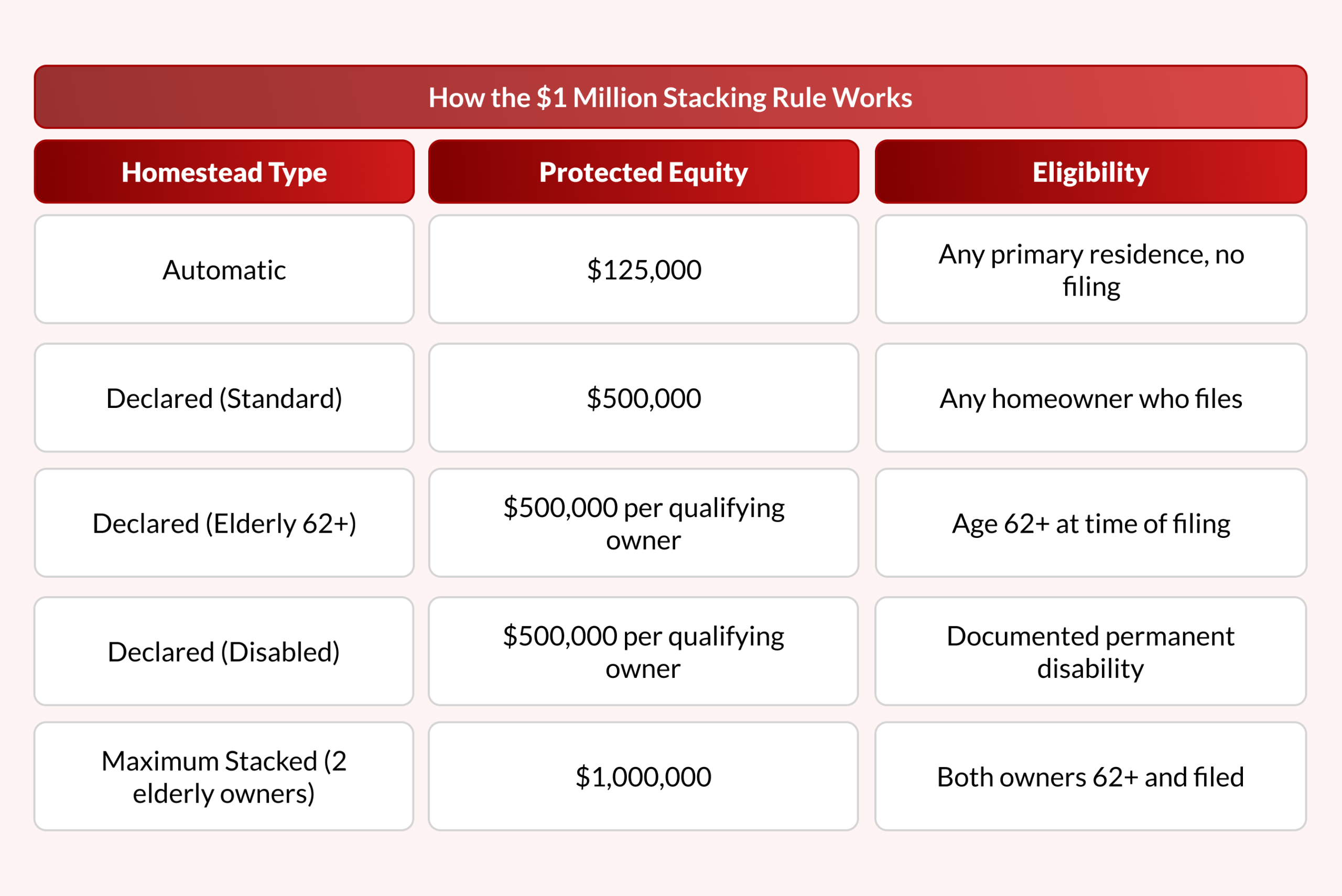
Source: MGL Chapter 188, Massachusetts Secretary of the Commonwealth, 2026.
For homeowners in higher-priced areas of Greater Boston, the stacked elderly homestead is often the difference between full and partial equity protection. A couple in Brookline with $900,000 of equity in a Beacon Street condo, both over 62, can shelter the entire amount with two filings.
Common Scenarios Where the Homestead Matters
Homestead protection sounds abstract until a real claim arrives. A few practical scenarios where it matters in Greater Boston:
A homeowner in Waltham faces a $200,000 civil judgment after a car accident exceeds insurance limits. With a declared homestead, $500,000 of home equity is shielded from the judgment creditor.
A retired couple in Belmont co-signs a business loan for an adult child. The business fails, the bank pursues the parents personally, and the declared homestead (with elderly stacking) protects up to $1 million of their equity.
A homeowner sells a triple-decker in Watertown and plans to buy a smaller condo. The sale proceeds remain protected for one year, allowing time to close on the new primary residence without exposure to unrelated creditors. Sellers navigating these timing questions often benefit from reviewing how the purchase and sale agreement interacts with proceeds protection during the closing window.
Frequently Asked Questions
Do I need a lawyer to file a Massachusetts homestead declaration?
No. The declaration form is one page and most homeowners file it without legal help. That said, if you hold the property in a trust, own it with non-spouse co-owners, or are filing as part of broader asset protection planning, a brief consultation with a Massachusetts real estate attorney is worth the cost.
Does the homestead declaration affect my mortgage or refinancing?
No. The declaration does not interfere with your mortgage, HELOC, or refinancing. Lenders take priority over the homestead because mortgage liens are voluntary. You can refinance at any time without filing a new declaration, although some title companies request a fresh filing as a precaution.
What happens to my homestead if I move?
The declaration is tied to a specific property. When you sell and move, you file a new declaration on the new primary residence. The old declaration becomes inactive once the property is no longer your principal residence, though sale proceeds carry one year of carryover protection under MGL Chapter 188.
Can I claim a homestead on a two-family or three-family home?
Yes, if you occupy one of the units as your primary residence. The protection extends to your ownership interest in the entire property, not just the unit you live in. This makes the declaration particularly valuable for owner-occupants of Greater Boston triple-deckers.
Does the homestead protect against property taxes?
No. Municipal property tax liens, betterment assessments, and water and sewer liens take priority over the homestead. The town can foreclose on unpaid property taxes regardless of your homestead status.
Do I need to refile the homestead every year?
No. A declared homestead remains in effect until you sell the property, move out, or file a release. There is no annual renewal and no recurring fee.
How does the homestead interact with bankruptcy?
In a Massachusetts bankruptcy, you can elect either the federal or the state homestead exemption. The state exemption ($500,000 declared or up to $1 million with elderly stacking) is usually more favorable than the federal exemption for Greater Boston homeowners. A bankruptcy attorney will run the comparison before filing.
Bottom Line
The Massachusetts homestead declaration is one of the highest-return $35 filings a homeowner can make. The automatic $125,000 protection is real but thin for Greater Boston equity levels, and the upgrade to $500,000 (or $1 million stacked for elderly couples) materially changes your exposure to unsecured creditors.
How Centre Realty Group Can Help
Our team helps buyers and sellers across Newton, Brookline, Watertown, Waltham, Belmont, and Boston coordinate with closing attorneys who handle homestead declarations as part of every purchase. If you are buying or selling and want to ensure the declaration is filed correctly at closing, we can connect you with the right attorney and walk you through the timing.
Disclaimer: This blog post is for informational purposes only and does not constitute financial, legal, or real estate advice. All data is based on publicly available sources as of 2026 and is subject to change. Please consult with a licensed real estate professional or financial advisor before making any decisions related to buying or selling property.
Centre Realty Group is a full-service real estate brokerage serving Greater Boston, including Newton, Brookline, Watertown, Waltham, Belmont, and the city of Boston. Our team helps buyers, sellers, and investors navigate one of the country’s most competitive housing markets.
Recent Comments